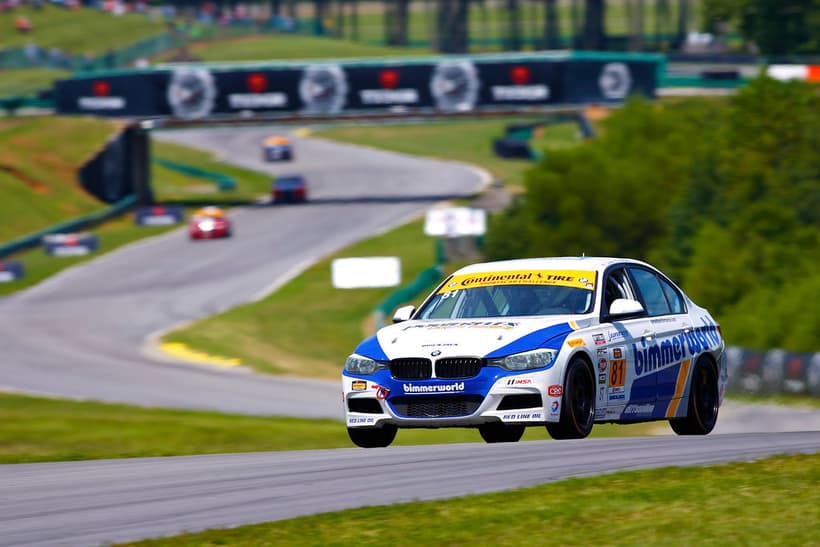
Track Tuning / Virginia International Raceway · USA

Full Course · USA

Commitment through the Esses.
Clean drive off the slow corners.

Virginia International Raceway is a fast, flowing, elevation-rich circuit defined by its blind uphill esses, long full-throttle straights and a fast, downhill final corner onto the front straight. The priority here is stability under sustained high-speed load, precise torque delivery through committed direction changes, and clean, early traction out of the slow and medium corners.

Character of the lap

High-speed commitment, traction off the slow corners

For the main power zones, the front straight, the back straight after NASCAR Bend and the long pull out of the Hog Pen, the calibration supports strong, sustained output with carefully managed boost and ignition. These sections reward top-end performance, but more importantly consistency at high airflow and high RPM, so the ECU never oscillates torque or intervenes under prolonged load.

The defining feature of VIR is the Climbing Esses, a blind, uphill sequence of high-speed direction changes taken at heavy lateral load. Here the calibration is built around absolute predictability. Torque delivery is kept linear and boost transitions are smoothed so small steering and throttle inputs translate into exactly the response the driver expects, with nothing that could unsettle the car as it crests and changes direction.

The slow and medium corners, Turn 1, Oak Tree and the infield, are traction-limited. The approach shifts to shaped torque and a flat, predictable curve so the driver can pick up the throttle early and drive out cleanly without wheelspin or ECU intervention.

Lap zones

How the calibration shapes each section.

01

Heavy braking · traction-limited

Turn 1

Hard braking from the front straight into a loaded right-hander.

I reduce the initial torque spike and shape boost to ramp in progressively, allowing earlier throttle application on exit without overwhelming rear traction. The goal is controlled, usable torque rather than peak output.

02

High-speed commitment

The Climbing Esses

Blind, uphill direction changes at heavy lateral load.

Torque request and throttle mapping are kept linear with no sudden boost transitions. Ignition and load targets are stabilised so the car stays planted and predictable as it crests and changes direction, with no mid-corner fluctuation that could unsettle the chassis.

03

Sustained load · power zone

NASCAR Bend → back straight

A long left feeding the fastest straight on the circuit.

Through the long left the car is heavily loaded while the driver is reapplying throttle, so delivery stays smooth and progressive, then transitions into full sustained power down the straight with boost and ignition aligned to hold output without intervention.

04

Medium-speed rotation

Oak Tree

A pivotal medium-speed corner onto the downhill section.

Focus on controlled torque ramp-in and a broad, flat torque curve so the driver can get to power early and carry speed onto the Roller Coaster, without a spike that pushes the car wide on exit.

05

Critical for lap time

The Hog Pen

A fast, downhill final corner, exit speed defines the lap.

A progressive but strong torque ramp lets the driver commit early while the car is still loaded and downhill, then builds into full power as the steering unwinds onto the front straight. Maximum exit speed without traction or stability issues.

Thermal management

Heat is part of the calibration.

Thermal management at VIR matters because of the sustained high-load running. The long straights and the continuous commitment through the esses push intake air, oil and exhaust gas temperatures up over a session, and Virginia summers add ambient heat on top. The calibration uses dynamic boost, ignition and lambda strategies to prevent heat soak from reducing output or triggering protection across multiple laps.

Calibration strategy options

Hot lap blend, or multi-map.

A single “perfect hot lap” calibration integrates everything into one continuous strategy. For more control, a multi-map setup can be configured.

Strategy 1

High Power · Straight-Line Bias

Designed for the front straight, the back straight and the pull out of the Hog Pen. Increased boost targets, higher torque request and optimised ignition for maximum sustained acceleration, while holding stability under continuous load.

Strategy 2

High-Speed Stability · Cornering Bias

Focused on the Climbing Esses, NASCAR Bend and the fast flowing sections. Reduced peak spikes, smoother boost delivery and highly refined throttle mapping for precise control under heavy lateral load and rapid direction change.

Strategy 3

Wet Mode · Low Grip Calibration

For damp or wet conditions. Softened torque delivery, reduced boost aggression and smoothed throttle mapping to prioritise grip and stability, especially through the high-speed esses where grip loss is most costly.

Full Course · USA

At Virginia International Raceway, the lap is won in the Esses and on the drive out of the Hog Pen. The calibration is built to deliver stable, committed power through the fast sections and clean, early torque off the slow corners, every lap.